


What I’m Pulling At
Almost every client I work with worries about healthcare costs. Not in the abstract. They worry about what happens as they age, and they worry about their parents right now.
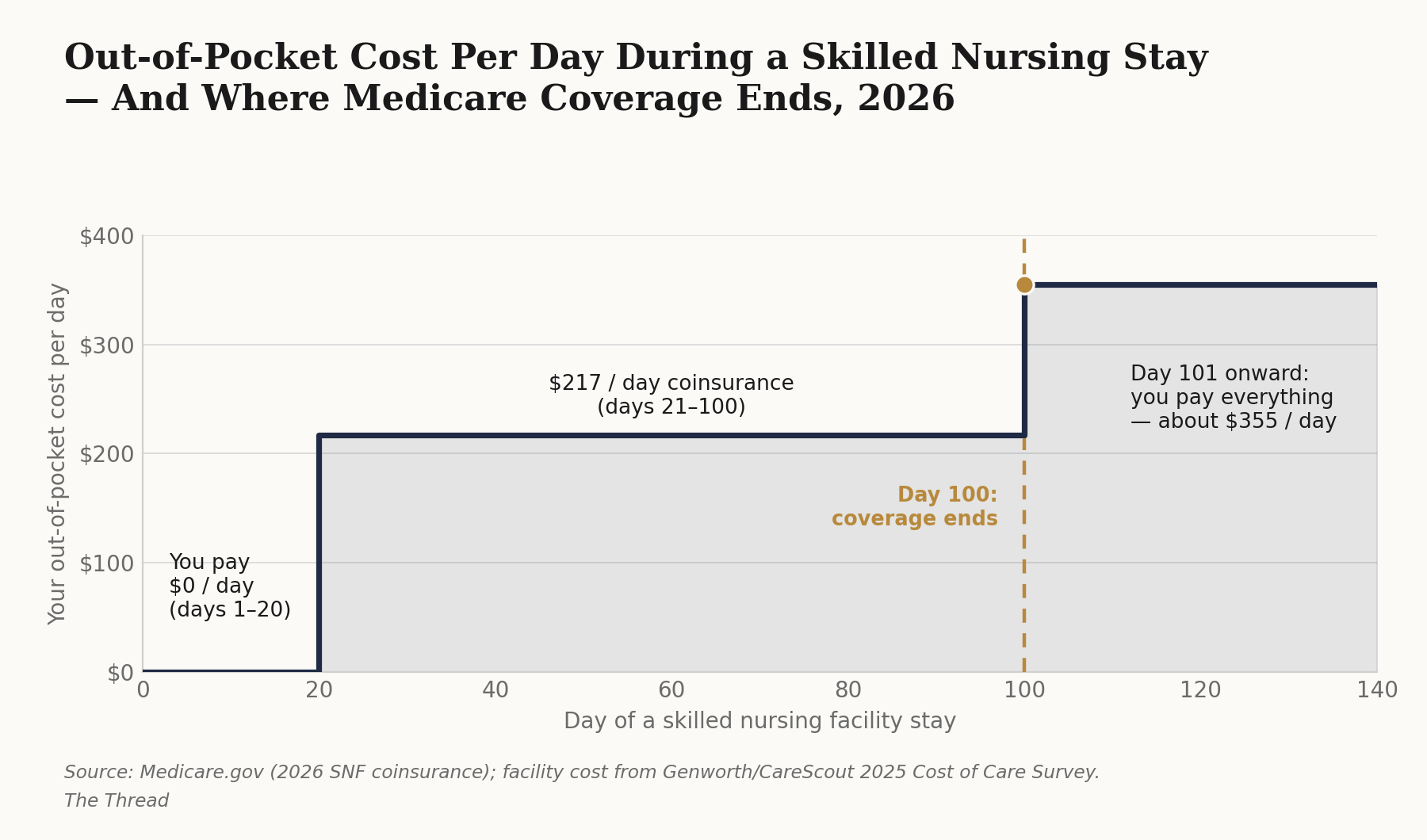
For years those worries stayed general. Lately they’ve turned specific. A parent breaks a hip, spends a week in the hospital, and moves to a nursing facility to recover. The family assumes Medicare has it covered. Then they learn the rules. Medicare pays the full cost for the first 20 days. For days 21 through 100, the patient owes $217 a day in 2026. After 100 days, Medicare pays nothing. And it never covers long-term custodial care — the day-to-day help with bathing, dressing, and eating that many older people end up needing most.
So the family starts paying out of pocket. A private room in a nursing home runs about $355 a day as a national median, or roughly $130,000 a year. In high-cost areas, including much of California, some facilities charge $800 a day or more. Suddenly the details no one studied — the 100-day limit, what counts as a qualifying hospital stay, how many ambulance trips are covered — matter far more than anyone expected.
I see a second version of this among people who are fully insured and still can’t get the care they want. They skip a screening scan because the bill is too high even with coverage. They wait weeks for an appointment, get 15 rushed minutes, and leave feeling unseen. So they find a doctor who doesn’t take insurance at all, and pay cash on top of the premiums they already pay every month.
Here’s the thread I keep pulling at. We have more health coverage in this country than ever before, and we spend more on healthcare than any nation on earth. And yet an insurance card turns out to be a smaller promise than most people expect. Sometimes the coverage simply stops short, the way Medicare stops at the nursing-home door. Sometimes it points you toward care that isn’t really there. Either way, what your card says you have and what you can actually get have drifted apart. This issue is about that distance, and what it means for your money.
Coverage Is Near Record Highs. Care Is Harder to Reach.
Start with the numbers, because they’re striking. Insurance coverage recently hit a record high — about 92% of Americans were covered in 2024, close to the most ever. That share has started to slip in 2026. The enhanced subsidies that made marketplace plans affordable expired at the end of 2025, and some people dropped their plans when the price jumped. But step back and the picture is still historic. More than 9 in 10 Americans are insured, and the country spends more on healthcare than any nation on earth: $5.3 trillion in 2024, or $15,474 for every person, and 18% of the entire economy. That total counts everything — government programs, insurance premiums, and the cash people pay out of their own pockets. Per person, it’s about twice what other wealthy countries spend.
By those measures, this should be the best-covered, best-served moment in American history. For a lot of people, it doesn’t feel that way. The reason isn’t that the coverage numbers are fake. It’s that having insurance and getting care have quietly become two different things.
The Best Providers Are Opting Out
The clearest sign is where the good providers are going. More and more of them are leaving the insurance system.
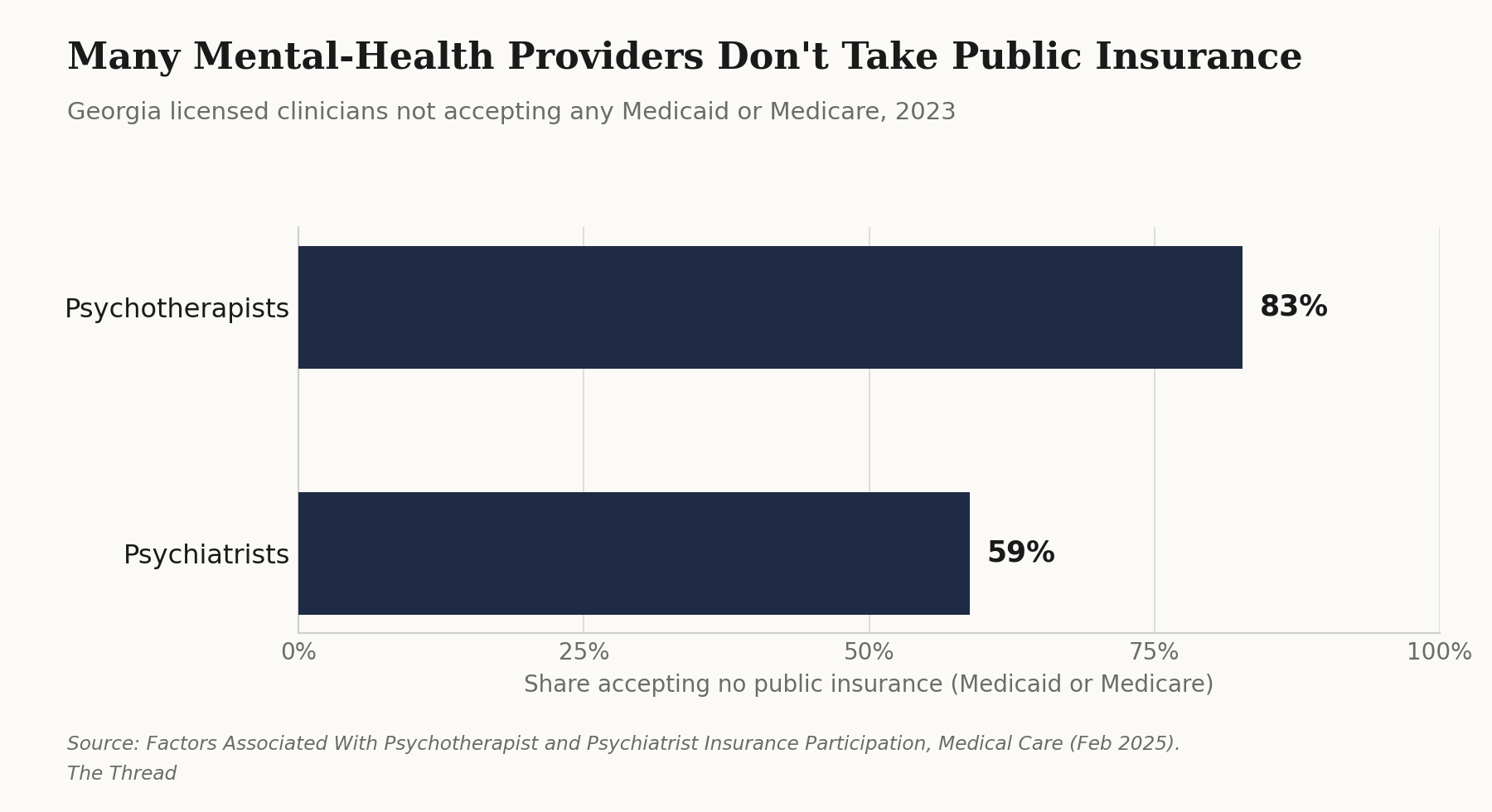
Mental health is the sharpest example. A 2025 study in the journal Medical Care looked at every licensed mental health clinician in Georgia. It found that almost 83% of psychotherapists, and about 59% of psychiatrists, took no public insurance at all. In plain terms, if you’re on Medicare or Medicaid, most of the state’s therapists and a majority of its psychiatrists are off-limits before you even call. Private coverage does better, though not by as much as you’d hope. Nationally, roughly 45% of psychiatrists take no private insurance, which is why even well-insured people often end up paying cash to find one with an opening.
Primary care is heading in the same direction. In “concierge” and “direct primary care” practices, patients pay a monthly or yearly membership fee for longer visits, faster access, and a doctor who isn’t rushing. A Johns Hopkins study in the journal Health Affairs found these practices grew about 83% between 2018 and 2023. Every doctor who switches to that model pulls a set of appointment slots out of the insurance system. The patients who stay on insurance have fewer doctors to see.
Even routine scans show the split. The same MRI runs far more at a hospital than at an independent imaging center a few miles away — same machine, same scan, same radiologist reading it. A big part of that gap is the hospital “facility fee,” an extra charge for using the building. A cash scan at a freestanding center often runs $400 to $700; the same scan at a hospital can cost two to three times as much. If you haven’t met your deductible yet, paying cash somewhere else can actually cost less than running it through your insurance at the hospital.
Put it together and you get the pattern my clients keep describing. They pay premiums every month. Then, to get the care they actually want, they pay again in cash. Insured, and still paying twice.
Why Providers Are Leaving
This isn’t about doctors being greedy. The pressures on them are structural, and they’ve been building for years.
Insurance payments to providers have been flat or falling, after inflation, for a long time, even as the cost of running a practice has climbed. To make the math work, a practice has to see more patients in less time. That’s the rushed 15-minute visit. It isn’t that your doctor doesn’t care. It’s that the economics of an insurance-based practice often leave no room for anything slower.
On top of that sits the paperwork. Prior authorization means getting an insurer to approve a treatment before it happens. Add the denials, the appeals, and the work of staying credentialed with each plan, and it can eat hours of staff time per patient. Hospital consolidation piles on, attaching facility fees to care that used to cost less. For a growing number of doctors, a cash practice is simply less exhausting, so they leave. And when doctors leave, for any of these reasons, access shrinks for everyone who depends on insurance.
When the Network Is a Ghost
Here’s the clearest version of the gap. In 2023, staff for the U.S. Senate Finance Committee ran a “secret shopper” test. They took the in-network mental health directories for a dozen Medicare Advantage plans, picked providers at random, and tried to book appointments. They succeeded 18% of the time. More than 80% of the listings were “ghosts” — wrong numbers, no callback, not accepting patients, or not actually in the network. State reviews have found the same pattern. A New York investigation found 86% of listed providers were unreachable or not really in-network.
Think about what that means. You’re paying premiums. You open your plan’s directory — the official list of providers it covers — and start dialing. Eight of ten are dead ends. The coverage is real on paper. The care behind it isn’t there. The studies that measured this looked hardest at mental health, where the shortage bites worst, but the mechanism isn’t unique to it. A network is only as real as the providers who actually answer the phone and take the plan.
It also connects back to why providers leave. A directory fills with ghosts partly because the people on it have stopped taking the insurance, moved to cash practices, or retired faster than the list gets updated. The opt-out and the ghost network are the same story told from two ends.
What This Means for You
A few things are worth knowing before you or a parent needs them.
It helps to understand how Medicare actually covers a nursing facility. The full benefit lasts 20 days. After that you owe a daily share through day 100, and nothing is covered beyond it. Long-term custodial care isn’t covered at all. That gap is exactly what long-term care insurance, dedicated savings, or a Medigap supplement plan are designed to fill, and the time to think it through is well before it’s needed.
For a parent in the hospital, one question is worth asking early: are they admitted as an inpatient, or under “observation”? Only a qualifying inpatient stay counts toward Medicare’s nursing-facility coverage, and families are often surprised to learn that a multi-day hospital stay didn’t qualify.
For scans and routine procedures, it’s worth asking the price at an independent imaging center, and asking for the cash or self-pay price even when you’re insured. Before your deductible is met, the cash price is sometimes the lower one.
Where to learn more. If you want a clearer handle on your own coverage, a few places give free help and don’t sell anything. For Medicare and supplement (Medigap) questions — including the ones that change every year — your State Health Insurance Assistance Program (SHIP) offers free, one-on-one counseling from people who aren’t paid by any insurer. Start there, or at Medicare.gov. For how plan types and tiers actually work, KFF and the official marketplace at HealthCare.gov are plain-spoken and non-commercial.
None of this is a knock on having insurance. Coverage still matters enormously. The point is simpler. Coverage is the beginning of the question, not the end of it. Knowing where it stops is part of protecting your money.
The Common Thread
We insure more people than ever and spend more than anyone, and still an insurance card and the care behind it keep drifting apart. The people who notice first are often the ones aging into the system, or helping a parent through it, which is to say most of us, eventually.
It’s worth being honest about what this is and isn’t. Some of this gap isn’t new. For families with thinner means, reaching good care has always been hard. What’s changed is that the friction now reaches people who used to sail through, and the concierge doctors and cash-price scans are, in part, a way of buying around a divide that was already there. So the story isn’t that the whole system is coming apart. Coverage is near record highs, and for many the picture really has improved. The gap is widening on certain fronts, and becoming visible to people who never had to think about it.
That’s the part worth watching. Coverage is not the same as care. Knowing the difference, and knowing where your own coverage stops, is one of the more personal financial questions worth getting ahead of.
Until next time, keep pulling.
— Matthew Davis
Disclosures
Matthew Davis is the co-founder of Sherwood Financial Partners, LLC (”Sherwood”). Sherwood is a registered investment adviser. This platform and this briefing are solely for informational purposes and do not intend to make an offer or solicitation for the sale or purchase of any specific securities, investments, or investment strategies. Investing involves risk and possible loss of principal capital. The information contained herein is not intended to convey or constitute legal or tax advice. Past performance is not indicative of future performance. Comments by viewers or third-party rankings and recognitions are no guarantee of future investment outcomes and do not ensure that a viewer will experience a higher level of performance or results. Public comments posted on this site are not selected, amended, deleted, or sorted in any way. If applicable, certain editing of personal identifiable information and misinformation may be deleted. The opinions expressed herein are those of certain Sherwood personnel and are subject to change without notice. The opinions referenced are as of the date of publication and are subject to revision due to changes in the market or economic conditions and may not necessarily come to pass. Any opinions, projections, or forward-looking statements expressed herein are solely those of author, may differ from the views or opinions expressed by other areas of the firm, and are only for general informational purposes as of the date indicated. Sherwood believes that the content provided by third parties and/or linked content is reasonably reliable and does not contain untrue statements of material fact or materially misleading information. This third-party content may be dated. This briefing may discuss and display charts, graphs, and formulas; these are not intended to be used by themselves to determine which securities to buy or sell or when to buy or sell them. Such charts, graphs, and formulas offer limited information and should not be used on their own to make investment decisions.


