


What I’m pulling at
Almost every client I have draws Social Security or is about to. So when the headline says the retirement trust fund runs out in 2032, the question I hear is always some version of the same one: will it still be there for me?
It’s the right question, and the short answer is yes. What’s less obvious is why a program this well understood, with a problem this well documented, still hasn’t been dealt with. That part has almost nothing to do with the math.
I came to planning from the investing side, so my instinct was always to look at the portfolio first. What surprised me was how critical Social Security turned out to be to whether a plan actually worked. The single decision of when to claim could move a plan from too tight to comfortable. That’s why a headline like this one doesn’t stay abstract for long.
First, what it is and why we built it
Before we talk about what happens in 2032, it’s worth remembering what this is and why it exists.
Social Security was signed into law in 1935, and the first checks went out in 1940. It was built for a specific problem: old age routinely meant poverty. When the committee that designed the program reported to Roosevelt in 1935, it found that somewhere between a third and a half of the country’s roughly seven and a half million Americans over 65 were dependent on public assistance or on help from their families. As late as 1959, about one in three Americans over 65 still lived below the poverty line. Today it’s roughly one in ten, and by the Census Bureau’s own estimate, without those benefits nearly four in ten seniors would fall below it.
That’s the context the 2032 conversation usually skips. This is one of the most effective things the federal government has ever built, and for a lot of people it’s the only thing standing between them and poverty. Which is why the question I keep turning to is this: why is a program that works this well suddenly at risk?
So why is it at risk?
Demographics — and it’s been coming for decades.
Social Security pays current benefits out of current payroll taxes. That works as long as enough people are working. In 1960 there were about five workers paying in for every person drawing benefits. Today it’s about 2.7, and it’s still heading down toward two. This year the Trustees lowered their assumptions for both birth rates and immigration, which pushed the long-term gap wider still.
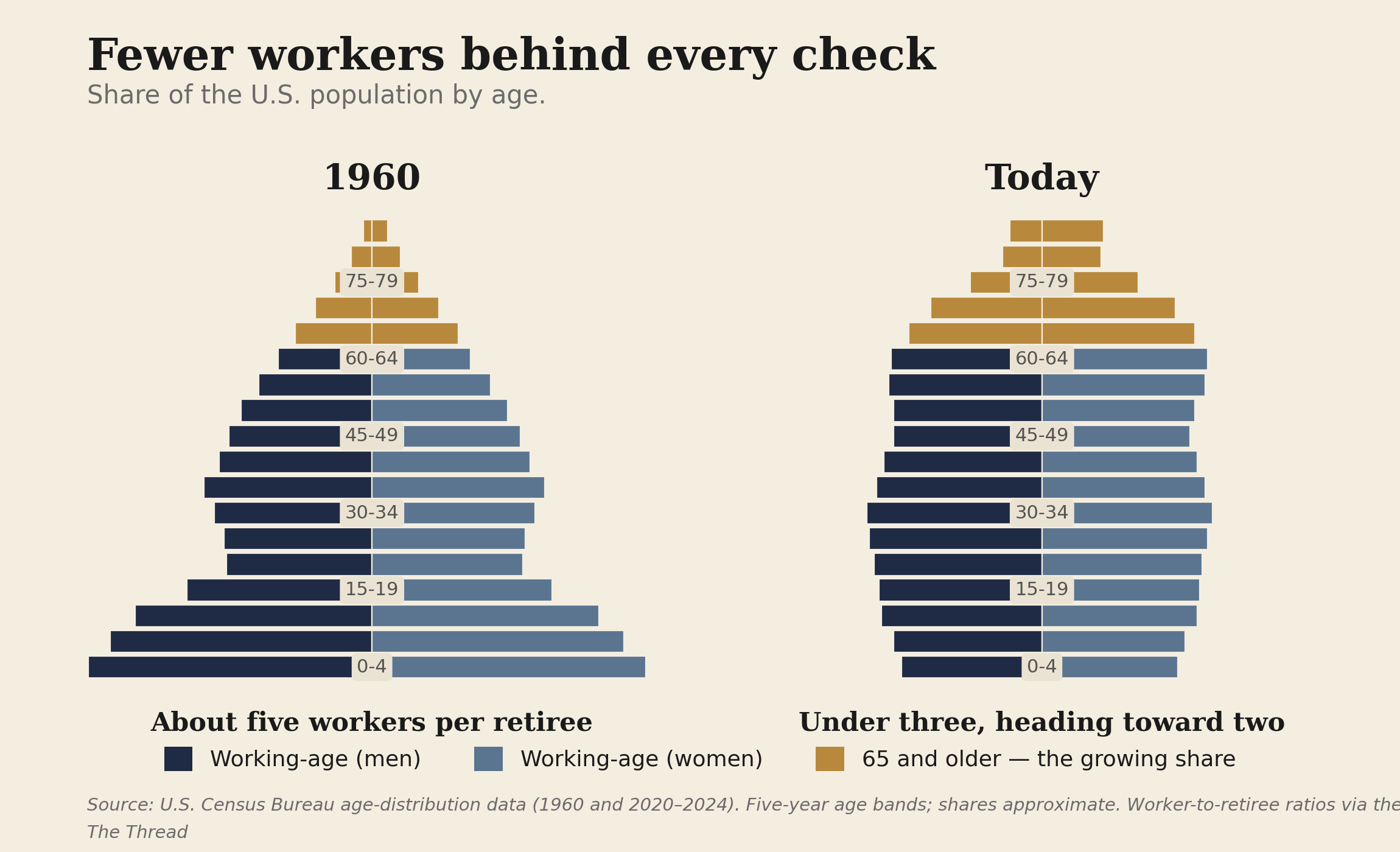
But the worker ratio is only half of it. The other half is that we’re living longer. In 1940, a man reaching 65 could expect about another 12.7 years of benefits. Today it’s approaching 20. Fewer people paying in, more people drawing out, for more years each. That arithmetic was always going to press on the system, and it has.
What 2032 actually means
Think of the trust fund as a reserve the program built up in the good years to cover the gap when payroll taxes alone fall short. That reserve, for the retirement half of the program, runs dry in late 2032. But payroll taxes keep coming in from every worker and every employer, and they would still cover about 78 percent of scheduled benefits. Worth knowing there’s a separate fund for disability, and if Congress let the two share resources, full benefits would run to 2034.
So the honest translation of “runs out” isn’t “gone.” It’s roughly a 22 percent cut, unless Congress does something. The Congressional Budget Office models it landing differently — about a 7 percent cut in 2032, then averaging 28 percent a year from 2033 through 2036. Either way, what’s being described is a hole, not a disappearance.
And it would land across the board, on every recipient, regardless of when they claimed. That matters, because most of what people ask me is about timing. Some want to claim early to lock in their number before cuts arrive. Others hold off, afraid of being trapped at a benefit that’s about to be reduced. Neither move does what people hope. A cut applies to whatever base you have, so claiming early doesn’t shield you from it. It just permanently lowers the base the cut would apply to.
Why it hits deeper than a percentage
Twenty-two percent can sound survivable in the abstract. I’ve heard people in Washington wave it off as something retirees can simply absorb. In a real retirement it rarely works that way.
Take the maximum benefit at full retirement age in 2026: about forty-two hundred dollars a month. Cut that by 22 percent and more than nine hundred dollars is gone. For a couple who both draw it clears a thousand; for two high earners, closer to eighteen hundred. Across all recipients the average is smaller — the nonpartisan Committee for a Responsible Federal Budget puts it near five hundred dollars a month, which even they describe as more than a typical retiree spends on groceries.
The standard advice is to trim the luxuries — make coffee at home instead of buying the seven-dollar latte. There aren’t enough lattes in a month to cover a five-hundred-dollar hole. That’s a month of food. It’s the car payment. It’s the difference between going out with friends and staying home.
And that last one matters more than it sounds. My clients aren’t trying to expand their lives in retirement; they’re trying to hold onto the one they built. One told me her goal, more than anything, was to keep up with her friends — not the luxury of it, the belonging, so that when she’s invited she doesn’t have to say no for financial reasons. That’s what I hear underneath a number like this. I should also point out that my clients come to me from a socioeconomically advantaged position, with savings in addition to Social Security. For people who don’t have that, a cut this size doesn’t trim the extras. It comes out of rent, groceries, medicine.
Can they actually do this?
This is where the word entitlement does real damage. People hear it and think of something given that wasn’t earned. Social Security is the opposite. It’s the most traceable money in your financial life — its own line on every pay stub, matched by your employer, trackable to the dollar on the SSA’s website. It isn’t given. It’s earned.
Which is what makes the legal reality strange. Even after a career of paying in, it isn’t a contractual obligation. It isn’t a pension. The Supreme Court settled that in Flemming v. Nestor in 1960: Congress can alter the terms. And the implication for 2032 is the part worth sitting with. If Congress does nothing, that’s allowed. Benefits simply fall. No law is broken. There’s nobody to sue.
There aren’t many places in life where we pay into something for forty years under a clear assumption and then watch the terms change after the fact. The law says that’s permitted. But if we call it what it is, it’s breaking a promise.
And that costs more than the household budgets it lands on. A market works when the rules are clear and get honored. When they’re quietly rewritten instead, it erodes the faith and trust in the markets and institutions — and the damage from that reaches well past any one program.
It can be fixed, and it has been before
What frustrates me is that none of this is new. We’ve known the shape of this problem for decades, and every Congress has left it for the next one. It’s the same criticism I have of public companies that can’t see past the next quarter — except the government can’t see past the next election, and what’s being deferred here runs for decades. This is a slow-moving ship heading for an iceberg. The earlier you turn, the smaller the correction. But a threat this slow never shows up on an election calendar, so it gets no attention, and the closer we get, the more drastic the turn has to be.
It can still be fixed. We’ve been almost exactly here before. In 1983 the math didn’t work either, and Congress waited until the very end — then Ronald Reagan, a Republican president, and Tip O’Neill, the Democratic Speaker of the House, about as far apart as two people could be, struck a deal. Part of how they did it was pushing cost onto future retirees by changing their benefits, which is part of why we’re back here now. But it held the program up for decades.
And that’s the thing to understand: this isn’t a math problem. Take the most-discussed fix, the cap on which wages get taxed. It sits at about $184,500, and a dollar earned above it isn’t taxed for Social Security at all. Only about six percent of workers earn above that line. Remove the cap entirely and you’d close roughly two-thirds of the shortfall — closer to half if you also credited those high earners with larger benefits for what they paid in. That’s the single biggest lever available, and it still doesn’t finish the job alone.
There are live proposals from both parties right now, and they’re all chasing the same blend: some mix of the tax rate, the cap, the retirement age, maybe the benefit formula itself. The only real difference between them is who pays.
Which is the honest reason this is hard. Every fix on the table takes something from an identifiable group. Higher earners who would pay more. Future retirees who would get less. Workers who would wait longer to collect.
That last one is worth more than a clause, because it’s the fix that sounds easiest. If you held the 1935 ratio of retired years to working years steady, the retirement age today would land closer to 70, and the retirement age was always meant to move as longevity rose. But the cost isn’t abstract. It’s the years people were counting on for something other than work — the ability to slow down, to be a grandparent, to stop. And it falls hardest on people whose life expectancy is shortest, who pay in on the same schedule and are least likely to live long enough to collect.
There are winners and there are losers, and the losers vote. So the avoidance makes a certain kind of sense, because every proposed fix creates some losers today. But the clock changes the math. If nothing happens, everyone drawing Social Security becomes a loser in 2032. That’s what eventually forces a decision. Which is why the real question probably isn’t whether it gets fixed — in a sense it self-corrects, badly, on its own. The question is what the fix looks like, and who it lands on.
The common thread
So, back to the question my clients actually ask. Will it be there?
Yes. “Gone” is the wrong word. The truer words are underfunded, on a known clock, with a long history of getting fixed at the last possible minute. What I can’t tell you is whether Congress moves early or late, or what mix of taxes and benefit changes it lands on. Given how our politics works, I’d expect late.
What I can tell you is that this isn’t a reason to panic-claim, or tear up a plan, or make a fear-driven move today against a cut that may never arrive in the form the headline threatens. It is a reason to pay attention — and to listen for the people offering real solutions, the ones honest enough to say who will carry the cost, while recognizing there isn’t much room left for people to lose.
And out of everything competing for your attention right now, this is the one I’d watch. Most of the noise won’t reach your kitchen table. This will. More than sixty million people draw these benefits, and CBO puts the reduction at $2.7 trillion over the first five years alone — enough that a cut wouldn’t just reshape household budgets. It would pull real money out of the wider economy.
I think of my job here as the lifeguard on duty. It isn’t my role to keep you out of the water, and it isn’t my role to tell you it’s calm when I can see the surf building. It’s to say there’s a current further out, it may get rough around 2032, and there’s still time for cooler heads to steer around it. If it comes, we’ll make the hard calls together, with a clear head. You won’t be doing it alone.
For now, the useful thing isn’t fear. It’s attention.
Until next time, keep pulling.
— Matthew Davis
Disclosures
Matthew Davis is the co-founder of Sherwood Financial Partners, LLC (”Sherwood”). Sherwood is a registered investment adviser. This platform and this briefing are solely for informational purposes and do not intend to make an offer or solicitation for the sale or purchase of any specific securities, investments, or investment strategies. Investing involves risk and possible loss of principal capital. The information contained herein is not intended to convey or constitute legal or tax advice. Past performance is not indicative of future performance. Comments by viewers or third-party rankings and recognitions are no guarantee of future investment outcomes and do not ensure that a viewer will experience a higher level of performance or results. Public comments posted on this site are not selected, amended, deleted, or sorted in any way. If applicable, certain editing of personal identifiable information and misinformation may be deleted. The opinions expressed herein are those of certain Sherwood personnel and are subject to change without notice. The opinions referenced are as of the date of publication and are subject to revision due to changes in the market or economic conditions and may not necessarily come to pass. Any opinions, projections, or forward-looking statements expressed herein are solely those of author, may differ from the views or opinions expressed by other areas of the firm, and are only for general informational purposes as of the date indicated. Sherwood believes that the content provided by third parties and/or linked content is reasonably reliable and does not contain untrue statements of material fact or materially misleading information. This third-party content may be dated. This briefing may discuss and display charts, graphs, and formulas; these are not intended to be used by themselves to determine which securities to buy or sell or when to buy or sell them. Such charts, graphs, and formulas offer limited information and should not be used on their own to make investment decisions.


